
Design
Landscape Lighting Design in Orange County
Design is the part most companies skip. We come out after sunset, set real fixtures on the house and in the planting, aim them while you watch, and only then decide what the system should be.
On your property
Our design process
- 01
Walkthrough at dusk
At dusk, Matthew walks the approach, entry, planting and outdoor living areas with you. We look at the surfaces that deserve attention, where people move after sunset and the views from inside the house. This walkthrough establishes a hierarchy before we select equipment, so the design serves the way you actually use the space.
- 02
Live fixture demo
We arrive after sunset with a working demo kit and a transformer. Fixtures go on the ground, get aimed, and get moved until the elevation looks right. You see the actual result rather than a rendering. Real fixtures and real output are set on your property at night, with beam spreads and color temperature chosen against your actual materials. You can compare the effect on stone, stucco, trunks and leaves, then ask for changes while the equipment is still movable. The consultation has no cost and no obligation to move forward.
- 03
Written lighting plan
Once the effect is right, the decisions become a fixture-by-fixture lighting plan. It records counts, fixture types, aiming notes and zoning, together with the transformer and wire plan. Layout, fixture count and zoning are decided before a price is quoted. That written document connects what you saw during the demo to what the crew installs. If the landscape is still being built, we coordinate sleeves and conduit with your landscape contractor before the hardscape goes in. The infrastructure can be planned early, with final aiming refined when the planting is in place.
- 04
Fixed written quote
The completed design leads to a fixed written quote. Fixture selection, counts and the agreed scope shape the price. You can review the plan and quote together and decide whether to proceed. For a phased installation, we design the whole property first and size the transformer for the final build, then install in stages. Planning the front and backyard together avoids having to undo work when the next area is added.
Who designs your lighting
Matthew Magga founded Orange County Night Lights in 2002 and still personally designs every system the company installs. He walks the property with you at dusk, sets real fixtures after sunset, and writes the plan the crew installs from. There is no sales-rep hand-off and no rotating subcontractors. Matt is a lighting designer and a licensed California contractor (CSLB #901505), and the same crew that installs the system also services it from the shop at 15561 Product Ln, Ste D9, Huntington Beach.
The consultation is an on-site evening visit, not an online estimate. It has no cost and no obligation to move forward. When you are ready, the design becomes a fixed written quote. Learn more about Matt and the company on our About page.
What a good design controls
Design principles
Light the architecture first
Begin with the house and its approach. Columns, arches, textured walls and the front door give the composition a structure; trees and planting support it rather than competing with it. The goal is not to brighten every surface equally. A gently revealed entrance can be more useful than a dramatically lit plant beside a dark doorway. During the demo, we compare the property from the street, the walkway and the windows, so the effect makes sense from the places where you experience it.
- Hidden sources — you see the lit surface, never the lamp
- Layering between facade, trees, path and hardscape so depth reads at night
Build layers, not floodlights
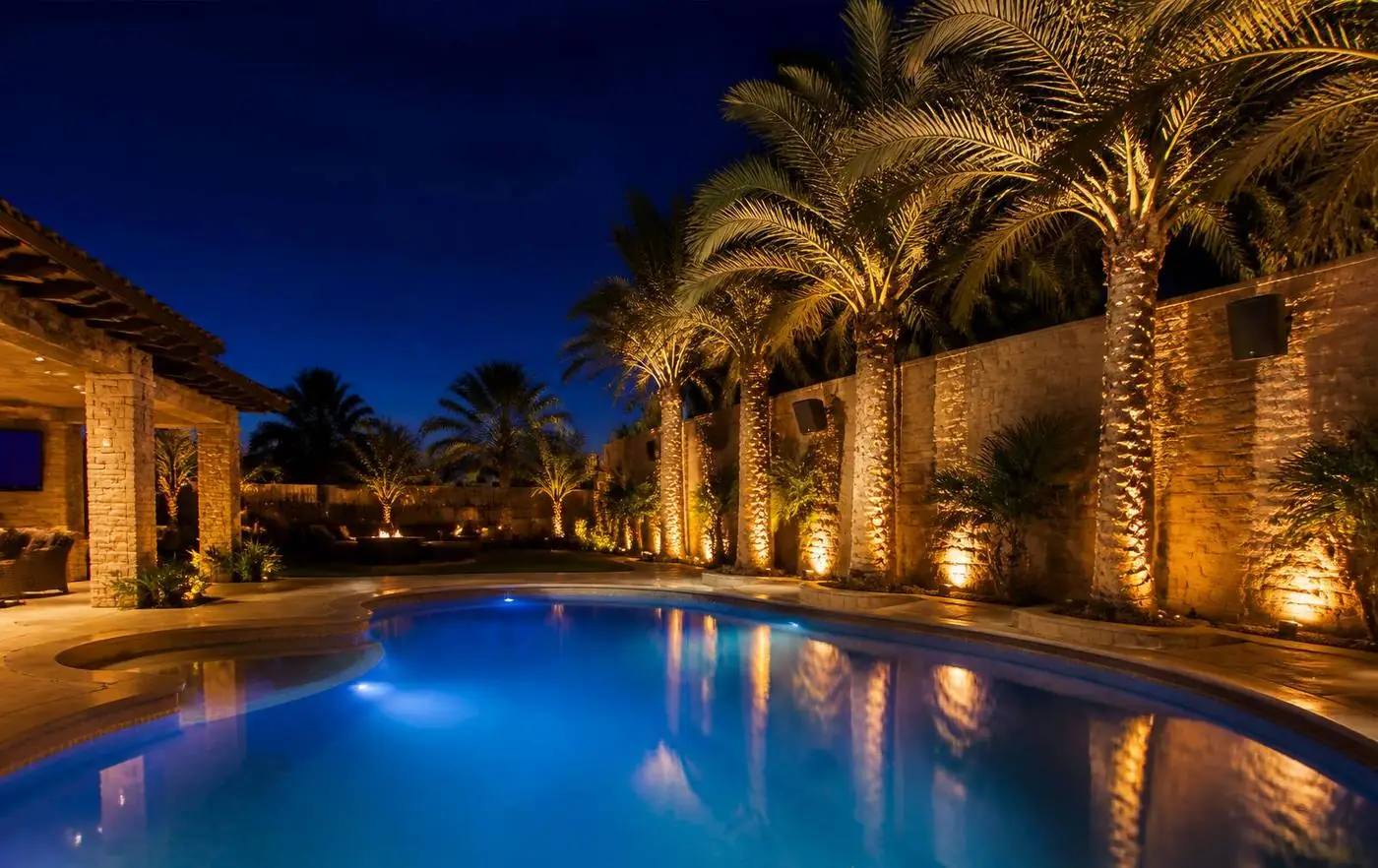
Uplighting gives trunks, columns and stone their shape. Path lighting provides low pools of light for the walk. Accent lighting gives a fountain, specimen plant or entry feature its own moment, while moonlighting sends soft downlight through a mature canopy. These layers work together to create depth without making the yard uniformly bright. Lighting design is mostly restraint. The difference between a professional system and a big-box one is how much light you choose not to use, and where you hide the source.
- One consistent warm color temperature across the whole property
- Zones and scenes so the system can run quietly or fully lit
Control glare and sightlines
You should see the lit surface, never the lamp. A fixture that looks discreet in daylight can become the most distracting thing in the yard after dark if its source faces a seat, window or approach. We adjust placement, aiming and beam spread during the live demo, using shielding where needed. Facade, trees, paths and hardscape are layered so depth reads at night. Zones and scenes let the system run quietly on ordinary evenings or more fully lit when you entertain, rather than forcing every fixture into the same effect.
Keep one warm color temperature
We choose one consistent warm color temperature across the property: typically 2700K, or 3000K where the architecture and materials call for it. The warmer 2700K appearance works well with gardens, stone and traditional finishes; 3000K can suit modern architecture with cooler-toned materials. Neither choice replaces good placement or glare control. We compare the light against your actual surfaces during the demo and avoid mixing temperatures on one elevation. Consistency helps the house, paths and planting read as one considered design rather than a collection of unrelated lamps.
Compare the two warm-white options in our guide to 2700K vs 3000K landscape lighting.
Planning a system that lasts
A lighting design is only as good as the equipment and wiring behind it. We specify solid brass fixtures for coastal air — FX Luminaire, SPJ, WAC Lighting and Unique Lighting — and bury and waterproof every run, sized so the fixtures at the end of a long run stay as bright as the ones near the transformer. The written plan includes the transformer and wire layout, with capacity for later phases when you want them.
Brass fixtures carry a lifetime warranty, and drop-in LED lamps are covered for two years. If you already have a system, we can diagnose dim zones, failed splices and voltage drop; see why landscape lights stop working and our landscape lighting repair service. For salt-air properties, see brass vs aluminum fixtures on the coast and coastal landscape lighting and salt air. After installation, lighting maintenance keeps aiming, lamps and connections in good shape.
Fixture by fixture
Sample lighting plan
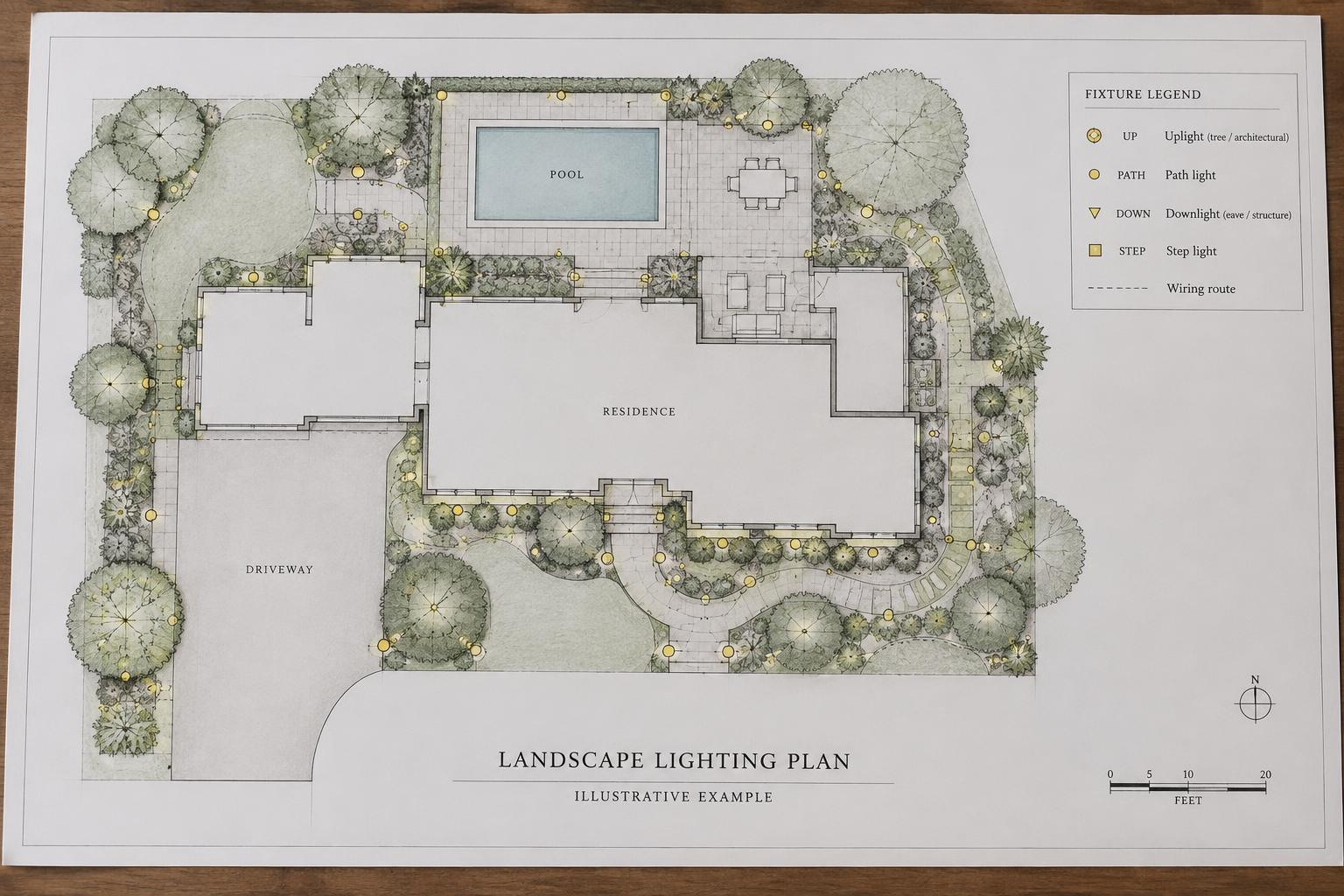
A lighting plan is more than a collection of dots around a house. Each fixture has a purpose, a target and a relationship to the surrounding layers. The layout identifies where the facade needs a wash, where a tree needs an accent, where path lighting supports safe passage and where a downlight can soften an entire area. A written plan also keeps the equipment decisions tied to the effect you approved during the evening demonstration.
Your plan includes fixture counts and types, aiming notes and zones, as well as the transformer and wire layout. These details give the installation crew a shared reference and make future additions easier to discuss. When a landscape contractor is still building the yard, sleeves and conduit can be coordinated before new hardscape closes off access. When an HOA needs documentation, the same layout becomes part of the review package rather than a separate design invented for the board.
Same view, after dark
Before and after lighting design
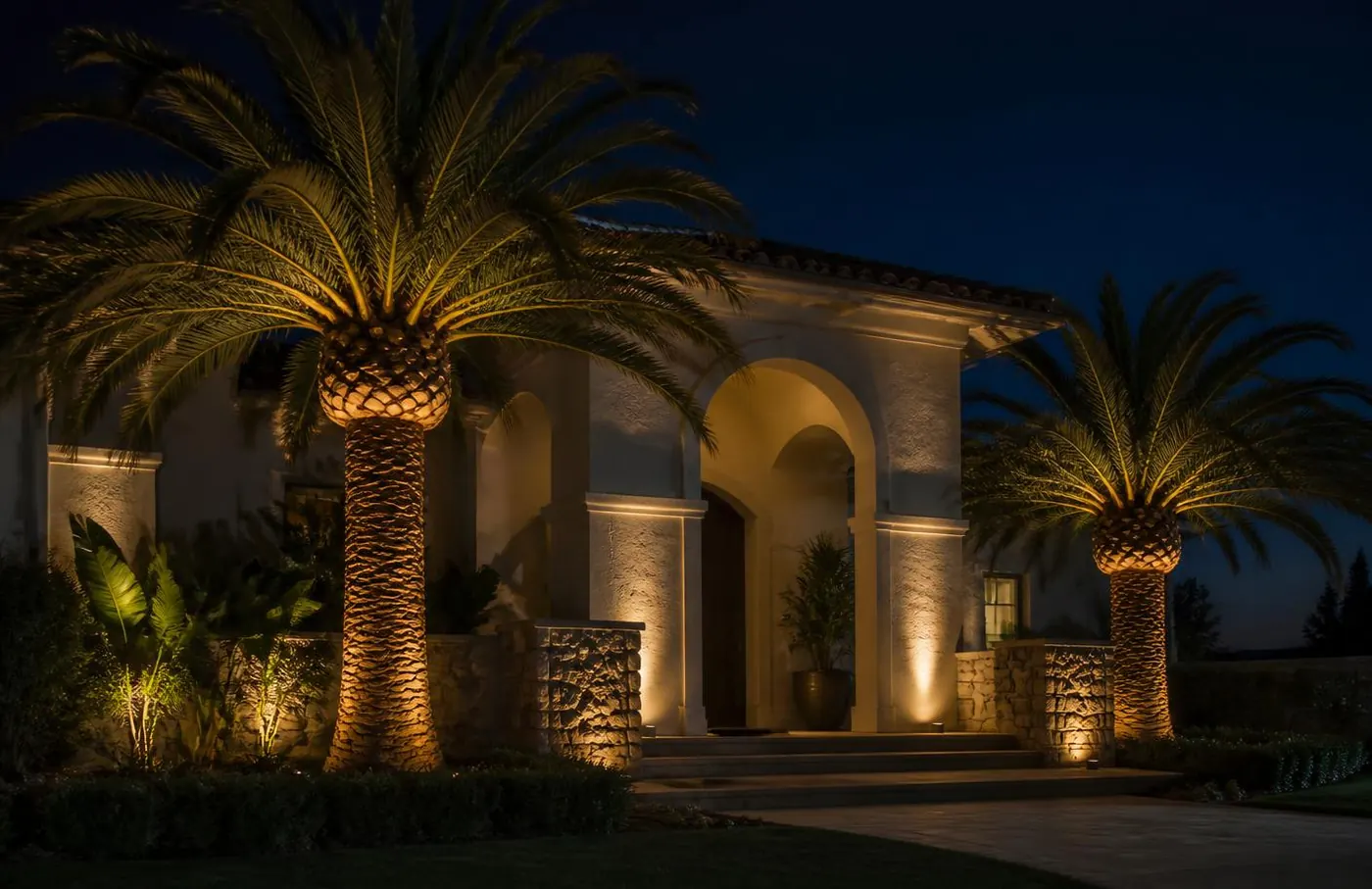
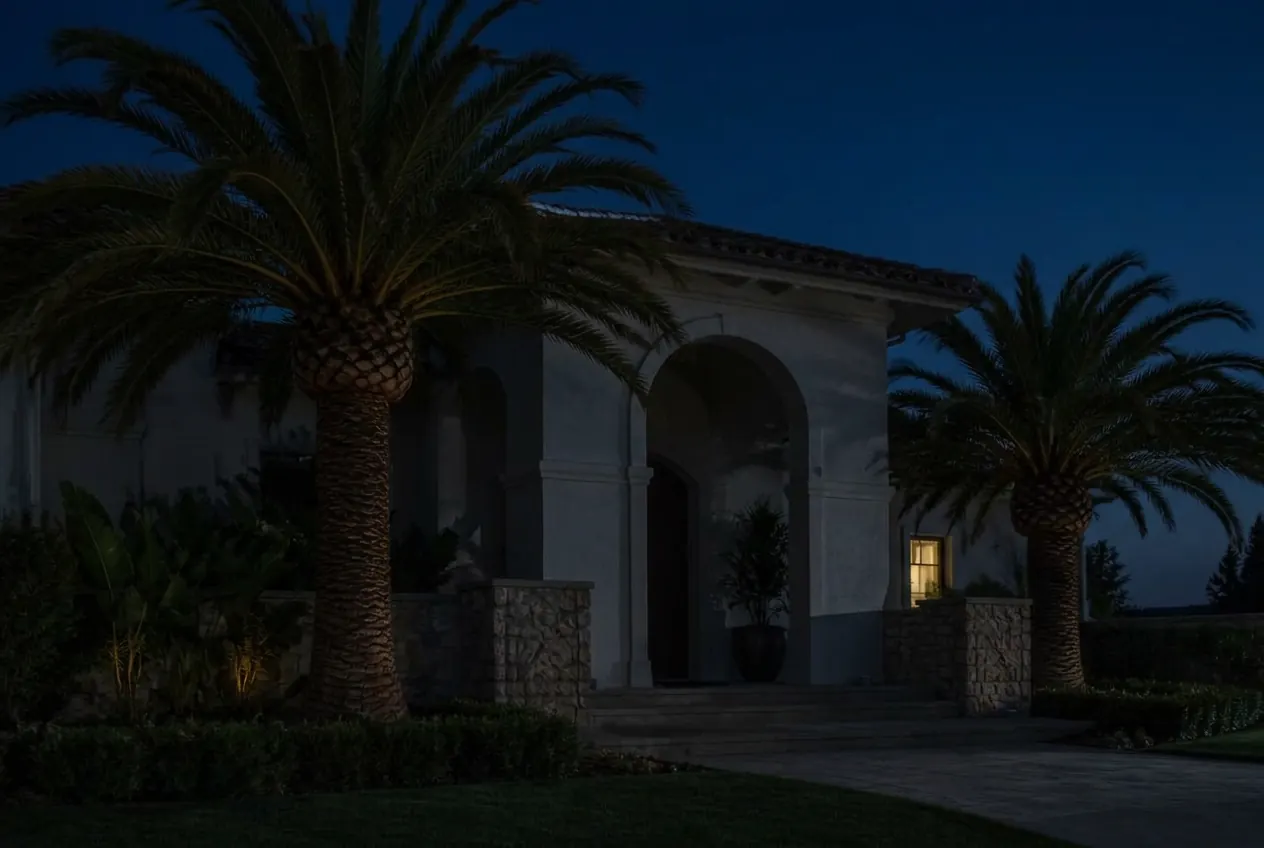
Facade & palm uplighting — Newport Beach
A stucco-and-stone entry that disappeared after sunset. We grazed the columns and arch with warm 2700K wash light and set narrow-beam brass uplights at the base of each palm, shielded so the source never reads from the street. The house now has depth, texture and a clear front door at night.
- Brass bullet uplights, 2700K
- Glare shields on every fixture
- Astronomic timer, dusk to midnight
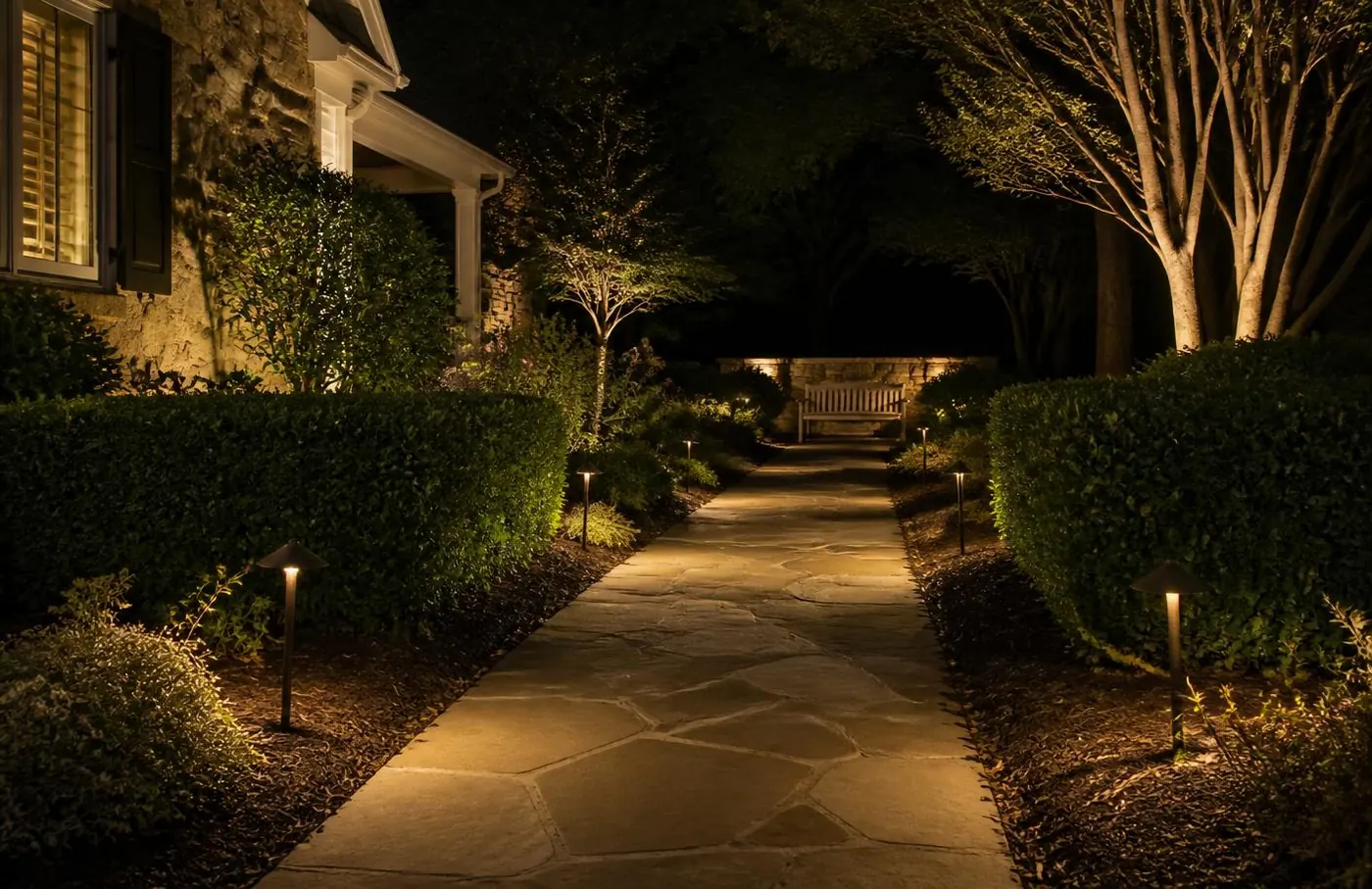
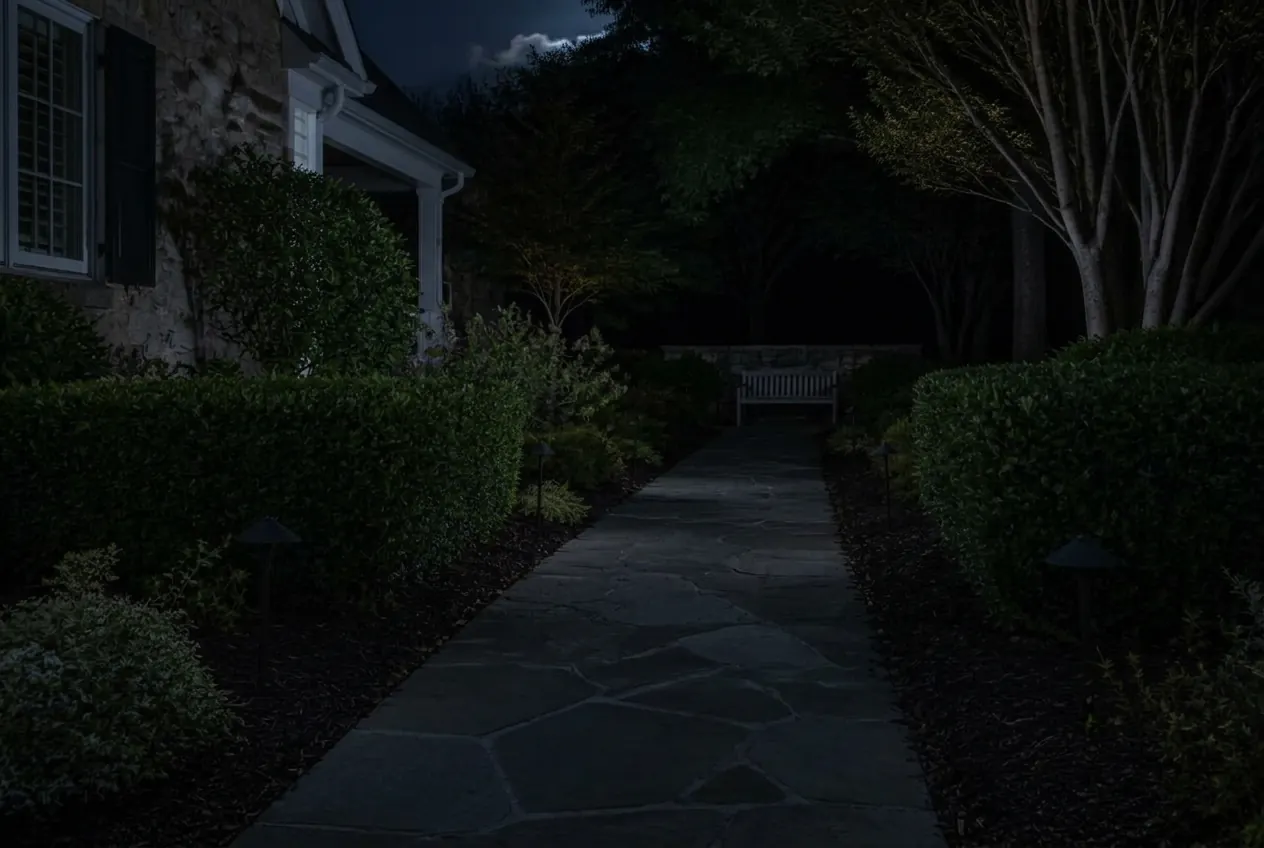
Walkway, hedges & safe passage — Huntington Beach
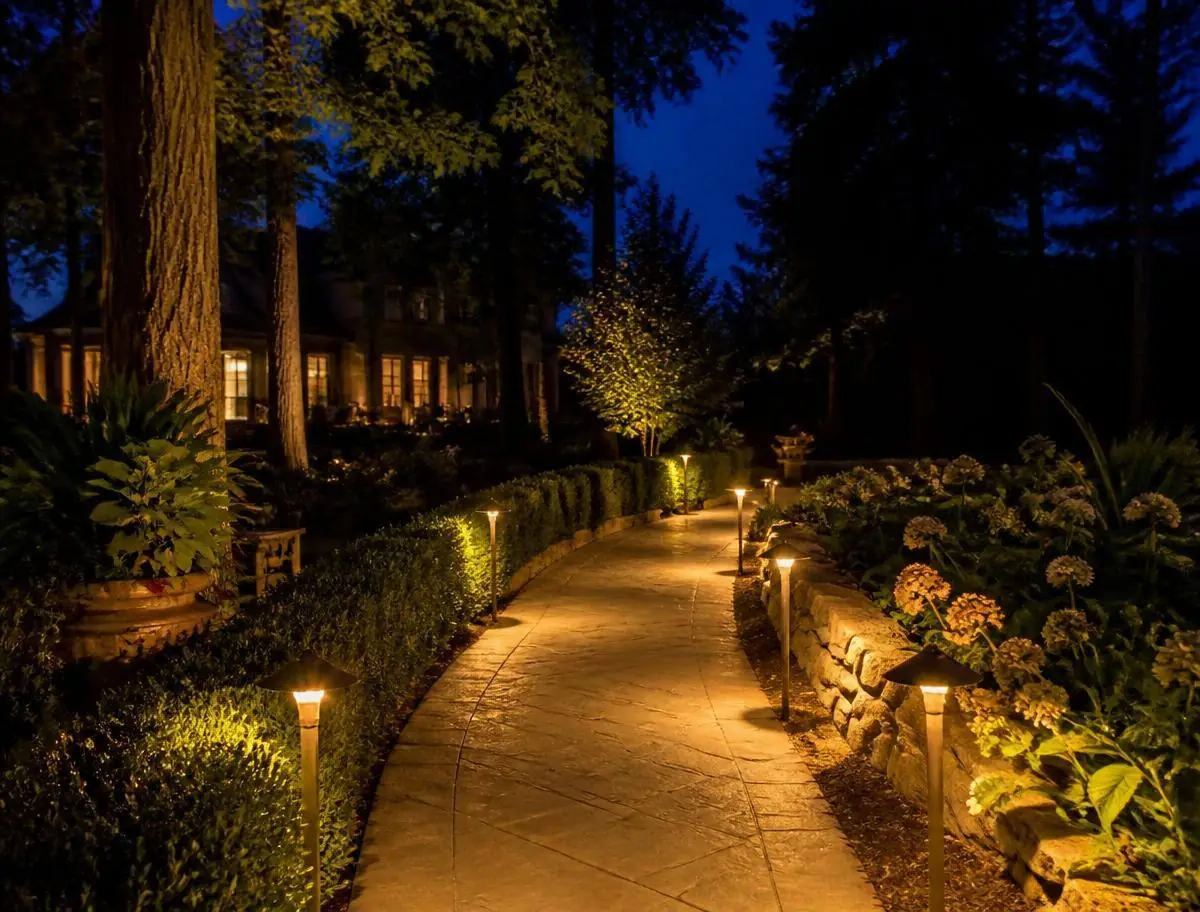
The flagstone walk to the front door was a guessing game in the dark. Path lights were spaced on site, at night, until the pools of light overlapped evenly with no hot spots — plus a soft downlight in the ornamental tree so the walk reads as one continuous path.
- Even pooling, no dark gaps between fixtures
- All wire buried and protected
- Moonlighting downlight from the canopy
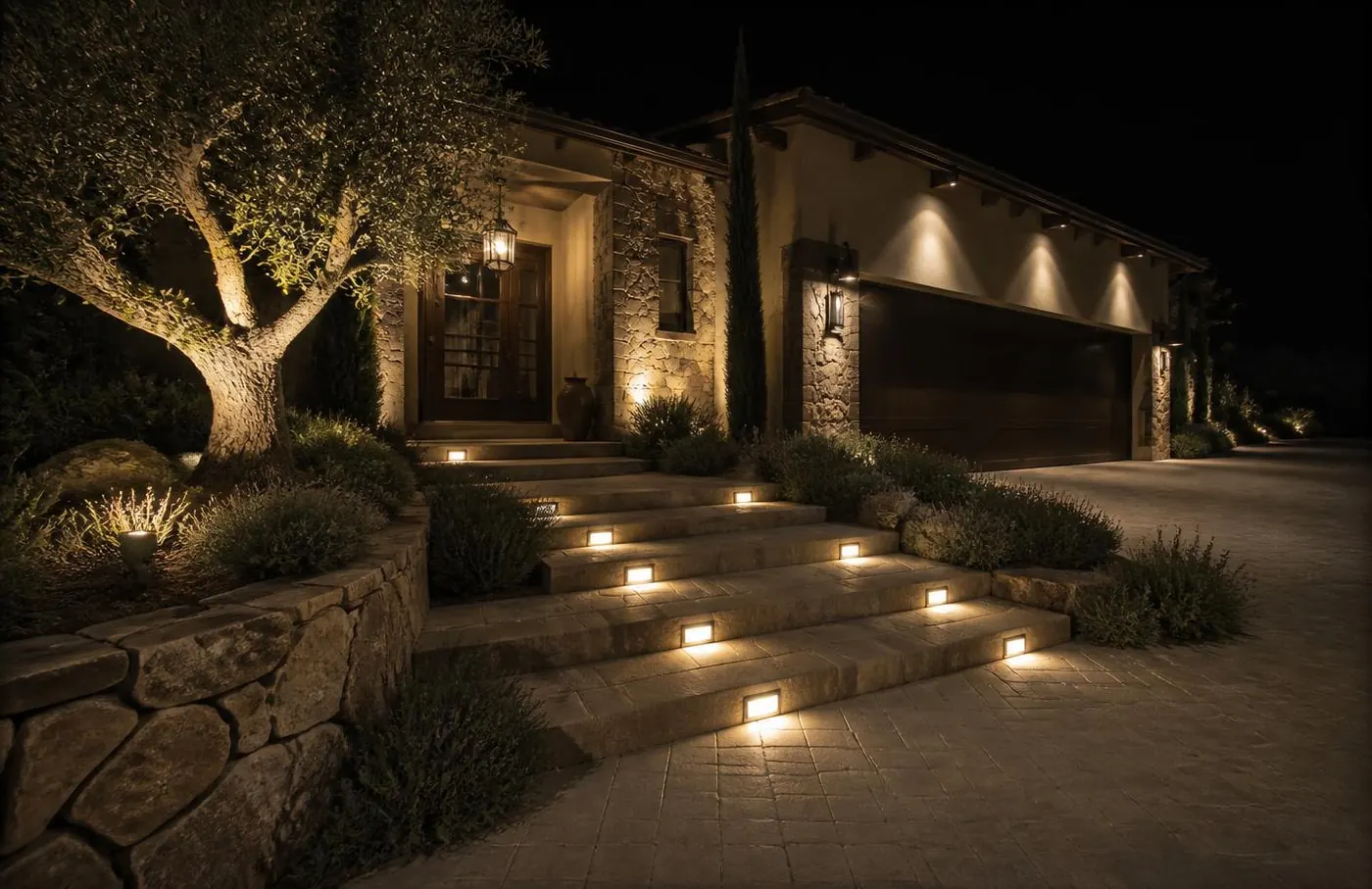
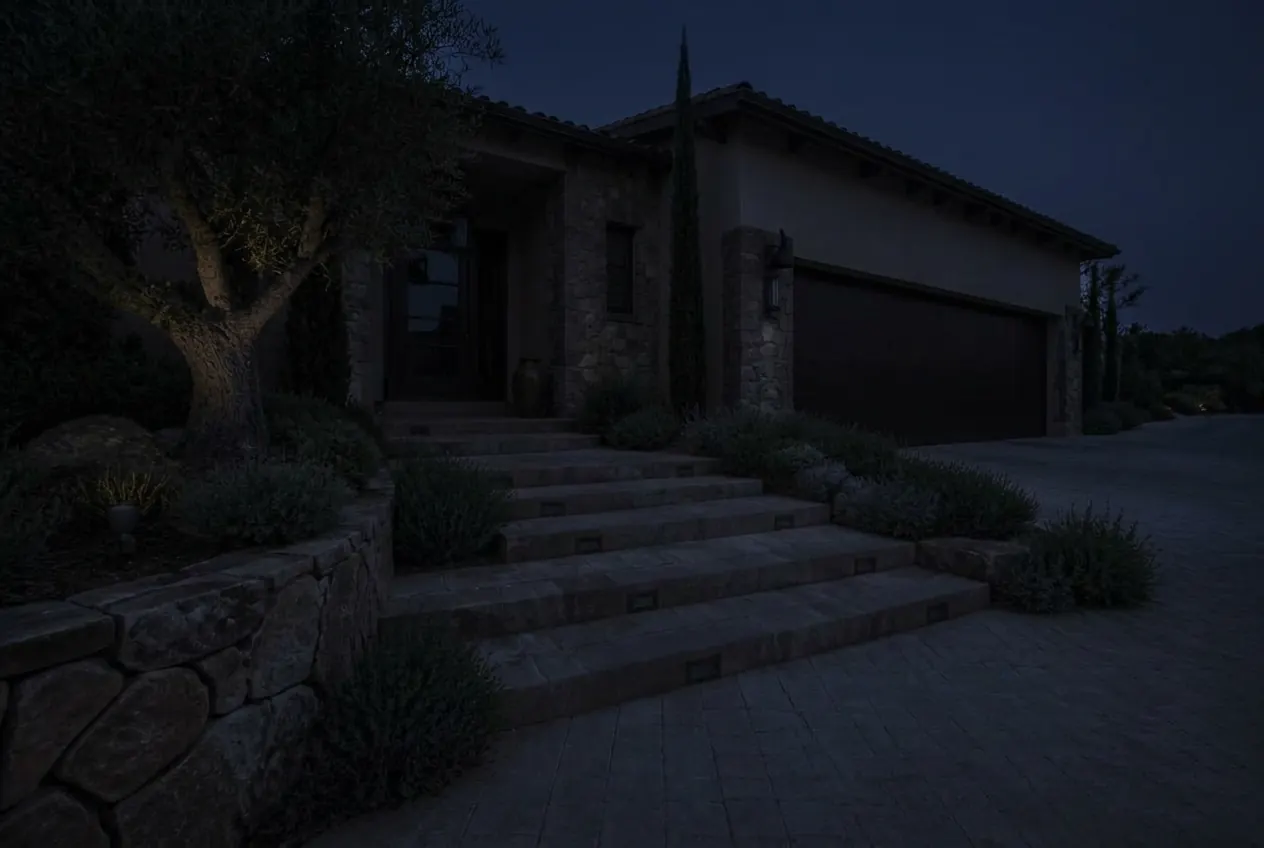
Front steps & driveway approach — Irvine
Four unlit stone treads and a steep grade change. Recessed hardscape lights went into the risers so the steps are legible without a single fixture in the sightline, and the olive tree got a low, wide uplight that lets the trunk carry the eye to the door.
- Recessed step lights integrated into masonry
- Wide-beam uplight on the specimen olive
- Facade downlights matched to the sconces
Community review
HOA and design-review submittals
We prepare submittals for HOA and architectural review in communities like Irvine, Laguna Niguel and Palos Verdes Estates. A fixture-by-fixture drawing helps explain the proposal in terms a reviewer can follow: fixture locations, types, aiming, color temperature and the areas being illuminated. Fixture cut sheets and the layout support the written package, so the board can review an actual design rather than a general promise that the lights will be subtle.
Preparation is not a guarantee of approval. Your association or architectural review board makes that decision, and we wait for written approval before installation when it is required. Bringing the review requirement into the design conversation early keeps the demonstration, drawing and proposed equipment aligned. If your landscaper is involved, coordinating sleeves and conduit before hardscape is installed also helps the lighting plan fit the wider project instead of becoming an afterthought once stone and planting are finished.
Explore our work in Irvine, Laguna Niguel and Palos Verdes Estates, or review our HOA landscape lighting service.
Outdoor lighting design for how you use the property
Outdoor lighting design starts with the way you arrive, gather and move through the yard after dark. The house and entry get the first layer of light. Trees, paths, steps, driveways and outdoor living areas are added only where they earn their place, so the property has depth instead of a uniform glow.
For planting and canopies, see tree and garden lighting. For terraces, steps and outdoor rooms, see deck and patio lighting. For the approach from the street, see driveway lighting. Architectural facade work is covered in our architectural lighting guide, and sloped lots are covered in the hillside landscape lighting guide. String lights over a patio or dining area can be designed into the same plan. When you are ready to have the design built, our outdoor lighting installation page explains how the crew installs from the written plan.
Fixed written quote
What it costs
Most projects range from $3,500 to $8,500 depending on scope. The useful comparison is the agreed design, not simply the number of lamps in a box. Fixture selection, the areas included and the infrastructure needed to connect them influence the quote. A front-entry composition with path and facade lighting is different from a plan that also layers a backyard, mature trees and outdoor entertaining areas. The evening demo helps establish which effects matter before we settle the scope.
The fixed written quote follows the on-site demonstration and fixture-by-fixture plan. Per-fixture pricing is based on the fixtures you select, and financing is available upon request. If you want to spread the installation across phases, the whole-property plan lets us size the transformer for the intended final system while prioritizing the areas you want first. For more detail about what is included and what changes the investment, see our Orange County landscape lighting cost guide.
Landscape lighting cost in Orange CountyAreas we design for
We design and install from our Huntington Beach shop for homes along the coast and inland, including Newport Beach, Irvine, Laguna Beach, Costa Mesa, Yorba Linda, Dana Point and the rest of the communities on our areas we serve map.
- Local shop in Huntington Beach
- We install FX Luminaire, SPJ, WAC Lighting, Unique Lighting and more
Google reviews
Homeowners on our lighting design work
Matt turned my otherwise dark hillside into a beautiful Mediterranean hillside. He was creative and suggested alternatives to the current lighting in style, in order to match the type of home I have. The quality is top n…
I have had the pleasure of working with Matt for several years in designing lighting for my home that is thoughtfully designed and executed. His attention to detail and artistry of light comes through in his work. He and…
Questions
Frequently asked questions
- How does the design consultation work?
- We visit after dark and set up real fixtures on your property, so you see the actual effect on your facade, trees and paths instead of imagining it from a catalog. We walk the design with you, adjust it on the spot, and leave you with a fixed written price. The consultation is free and comes with no obligation.
- Do you provide a drawing or plan?
- Yes. You get a fixture-by-fixture layout with counts, fixture types, aiming notes and zoning, plus the transformer and wire plan. It is the document our crew installs from, and it doubles as the HOA or architectural submittal when your community requires one, which saves you from preparing a separate package for the review board.
- Can you design lighting for a landscape that is not built yet?
- Absolutely, and it is the cheapest time to do it. We coordinate sleeves and conduit with your landscape contractor before the hardscape goes in, so no one is trenching through a finished yard or coring new stone later. The lighting plan can be finalized once planting is in, while the infrastructure is already in place.
- What makes a lighting design look professional?
- Hidden sources, layering and consistency. You should see the lit surface, never the lamp. Facade, trees, paths and hardscape are layered so depth reads at night, and every fixture runs one consistent warm color temperature. Zones and scenes let the system run quietly on most evenings or fully lit when you entertain guests.
- Can the design be installed in phases?
- Yes, and it is common. We design the whole property up front and size the transformer for the final build, then install in stages, often the front of the house first and the backyard later. Because the plan is complete from the start, nothing has to be torn out or redone when the next phase is installed.
- What color temperature is best for landscape lighting?
- We normally use 2700K for a warm, incandescent-like appearance. A consistent 3000K can suit very modern architecture with cool-toned materials. We compare the light against your actual facade and planting during the evening demo, rather than choosing from a screen. Do not mix temperatures on one elevation; consistency across the property helps the whole design feel intentional.
- Who designs and installs the lighting?
- Matthew Magga, the owner and lighting designer, personally designs every system. He walks the property with you at dusk, sets real fixtures after sunset and writes the plan. The same crew installs and services the system from our Huntington Beach shop. There is no sales-rep hand-off.
- How do I know the lighting will not look too bright or overdone?
- Restraint is part of the design. We light the architecture, a few key trees and the paths you actually use, and we hide the sources so you see the surface, never the lamp. During the live demo we aim and move fixtures with you until the effect feels right, and we use one consistent warm color temperature across the property.
- What fixtures and warranties do you use?
- We install solid brass fixtures from FX Luminaire, SPJ, WAC Lighting and Unique Lighting, specified for coastal air, with buried and waterproofed wiring. Brass fixtures carry a lifetime warranty, and drop-in LED lamps are covered for two years. The written plan sizes the transformer and wire so the system can also be expanded later.
On your property, after dark
Schedule an evening demo
We bring real fixtures to your property, show you the result, and deliver a fixed quote. No pressure.
Keep exploring
Related guides
- Brass vs Aluminum Fixtures on the Coast →
- 2700K vs 3000K: Choosing a Color Temperature for Landscape Lighting →
- Why Landscape Lights Stop Working (and What to Check First) →
- Planning Your Landscape Lighting Budget in Orange County →
- DIY vs. Professional Landscape Lighting: What to Know →
- Architectural Lighting for Orange County Homes →
- How to Choose a Landscape Lighting Company in Orange County →
- Hillside Landscape Lighting for Sloped Orange County Yards →